At a Glance
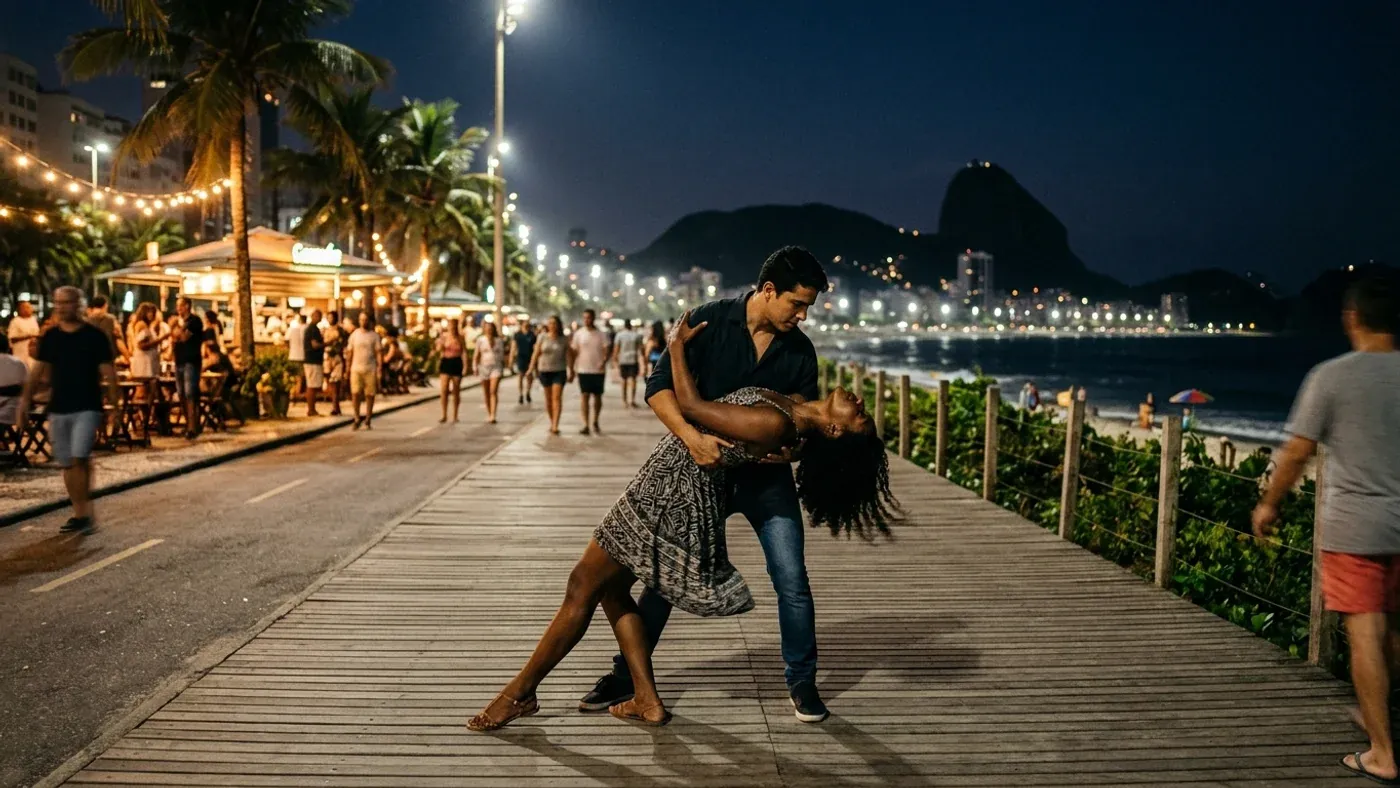
The humid air sticks to your skin as the DJ transitions to a classic Kassav’ track. On the floor, a dancer dips their partner, head tracing a slow, perfect circle just inches from the polished wood. This is Brazilian Zouk, a dance of Caribbean heritage and Brazilian soul, and South America is where it lives.
The Great Divide: Rio vs. São Paulo
To understand Zouk in Brazil, you have to understand its two poles. The dance evolved differently in each city, creating two distinct styles. Rio-style Zouk, often called Lambazouk, holds tight to its Lambada origins with a raw, circular, and playful energy. São Paulo developed the slower, linear, and technical style heavy on body isolations that has become the dance’s primary global export.
This stylistic split defines the landscape. Dancers often have a strong preference, but a trip covering both cities reveals the complete story of the dance. For a deeper dive, explore our guide on Brazilian Zouk vs Lambada vs Zouk-Love Explained.
| City | Vibe | Musicality | Known For |
|---|---|---|---|
| Rio de Janeiro | Playful, grounded, energetic | Faster, percussive, lambada-driven | Traditional roots, circularity |
| São Paulo | Technical, sensual, polished | Slower, melodic, R&B/pop remixes | Head movements, body isolations |
| Buenos Aires | Technical, focused, tango-influenced | Primarily São Paulo style | Posture, strong fundamentals |
Brazil’s Zouk Capitals
While the two giants define the conversation, each Brazilian city offers a unique accent on the dance. From the historical heart of Rio to the sprawling metropolis of São Paulo, you are dancing in the culture that created the movement.
Rio de Janeiro, Brazil
Rio is the spiritual home. The scene here feels connected to the city’s DNA, less about studio polish and more about cultural expression. This is where pioneers like Renata Peçanha first adapted Lambada to Zouk music, and that history is palpable.
Socials in Rio often happen at dedicated schools that are pillars of the community. Finding the right one is key to unlocking the scene.
São Paulo, Brazil
São Paulo is the global engine of Zouk. It’s the world’s largest and most competitive scene, with socials every night and an intense training culture. This is where the modern style was codified and exported to the world.



Beyond the Big Two
Beyond the metropolises, Brazil’s regional scenes offer focused training and distinct local character. These smaller, tight-knit communities are known for producing technically excellent dancers and providing a welcoming atmosphere for visitors willing to venture off the main tourist track.
Curitiba, Brazil
Curitiba has a reputation for producing a disproportionate number of professional dancers. The scene is smaller but serious, with a strong emphasis on clean technique and musicality. It’s an ideal destination for dancers focused on intensive training without the overwhelming scale of São Paulo.
Porto Alegre, Brazil
In Brazil’s far south, Porto Alegre’s scene has a distinct regional flavor, influenced by its proximity to Uruguay and Argentina. It’s a practical hub for a multi-city dance trip through the Southern Cone, with dedicated schools sustaining a consistent local scene.
Buenos Aires: Tango’s Zouk-Dancing Cousin
Across the border, the continent’s largest non-Brazilian scene thrives by infusing Zouk with a different kind of partner dance DNA. Buenos Aires has wholeheartedly adopted São Paulo-style Zouk, but its dancers bring a unique sensibility shaped by the city’s deep-rooted tango culture.
This translates to a focus on posture, balance, and a subtle, grounded connection. The scene is concentrated in neighborhoods like Palermo, with a handful of dedicated studios and weekly socials. For a visiting dancer, it offers incredible value and a chance to see Zouk filtered through a different, but equally sophisticated, cultural lens.
Buenos Aires, Argentina
The Argentine capital offers a unique Zouk experience. The community is passionate and growing, with a strong emphasis on technique. It’s an affordable, culturally rich city that pairs perfectly with a trip to Brazil.
Festivals on the Horizon
Planning a trip around a major festival is a perfect way to anchor your travels. While Brazil has a rich domestic congress circuit, the global calendar offers world-class events that draw top talent from South America and beyond. The festivals listed here are a snapshot of the international scene where Zouk plays a central role.
- SEP11
- SEP17Madrid Zouk Bachata Festival 2026BachataZouk
- SEP242026 CALDAC ConventionSalsaBachataKizombaZouk
- SEP24
- SEP25


For a comprehensive look at the year’s biggest events, check out the full Zouk festival calendar.
See all Zouk festivals